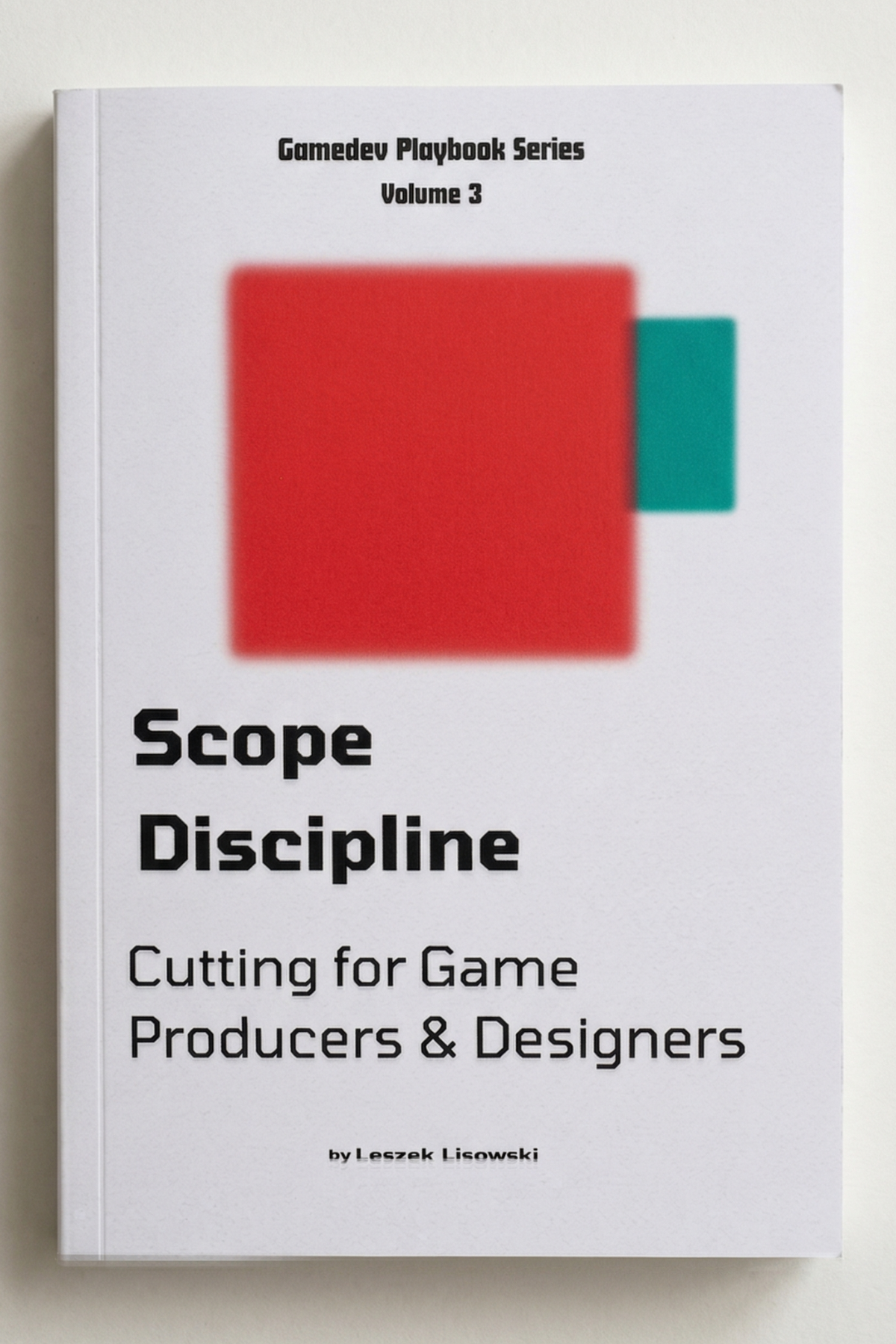
Scope Discipline
Cutting for Game Producers and Designers
Slice into ship units • Say no cleanly •
Protect the core experience
Most projects don’t fail because they lack ideas.
They fail because too many ideas enter production without clear trade-offs.
Scope expands gradually. Decisions accumulate. Cutting becomes reactive and late.
This volume introduces a structured approach to controlling scope without breaking the game.
When Scope Becomes Unmanageable
Scope rarely explodes overnight.
It grows through small, reasonable decisions.
A feature is extended. Another idea is added. A system becomes more complex than planned. Each change feels justified in isolation.
Over time, the project becomes harder to manage. Priorities blur. Delivery slows down. Cutting becomes painful because too much is already interconnected.
Without a clear structure for scope, teams are forced into late, disruptive decisions.
What This Volume Solves
This volume focuses on turning ideas into controlled, shippable scope.
It provides a structured approach to slicing features, prioritizing work and managing change without destabilizing production.
The goal is to maintain control over scope from early planning through active development, while protecting the core experience of the game.
Key Areas Covered
- Defining scope as a clear, shared contract
- Slicing features into manageable, shippable units
- Prioritization based on real trade-offs and dependencies
- Building and maintaining effective kill lists
- Handling change requests in a controlled way
- Protecting the core experience during cuts
How This Volume Is Structured
The content follows the same working model used across the series.
Each section combines:
- principles that define effective scope control
- anti-patterns observed in real production environments
- practical tactics for managing scope under pressure
- templates supporting slicing, prioritization and change decisions
- anonymized case examples showing scope creep and recovery
The focus is on making scope decisions explicit and manageable.
What You’ll Find Inside
This volume includes practical tools for managing scope:
- feature slicing models for different types of gameplay systems
- prioritization frameworks based on constraints and dependencies
- kill list structures that allow fast, controlled cuts
- change request flows supporting clear evaluation and communication
- real-world examples showing how scope expands – and how to regain control
Who is this for
Producers / Project Managers
Managing scope, priorities and delivery constraints across the project.
Designers
Working with features and systems that must be shaped into shippable forms.
Team Leads
Balancing ambition with execution and protecting delivery timelines.
Where This Volume Fits
This volume focuses on scope as a core control mechanism in production.
It builds on alignment (Volume 1) and planning (Volume 2), and connects directly to execution layers in later volumes.
Without alignment, scope lacks direction. Without planning, scope lacks structure.
This volume can be used independently or as part of a broader production system.
No. This volume is designed to work as a standalone resource.
Both. The focus is on controlling scope from the start and making cutting decisions manageable when needed.
The approach applies across the entire production timeline, from initial planning to late-stage stabilization.
Yes. The book includes templates and structures that can be used directly in production.
Thank you for subscribing!
Have a great day!
By subscribing, you agree to receive emails about this workbook and occasional updates about other creations. You can unsubscribe anytime. Privacy Policy