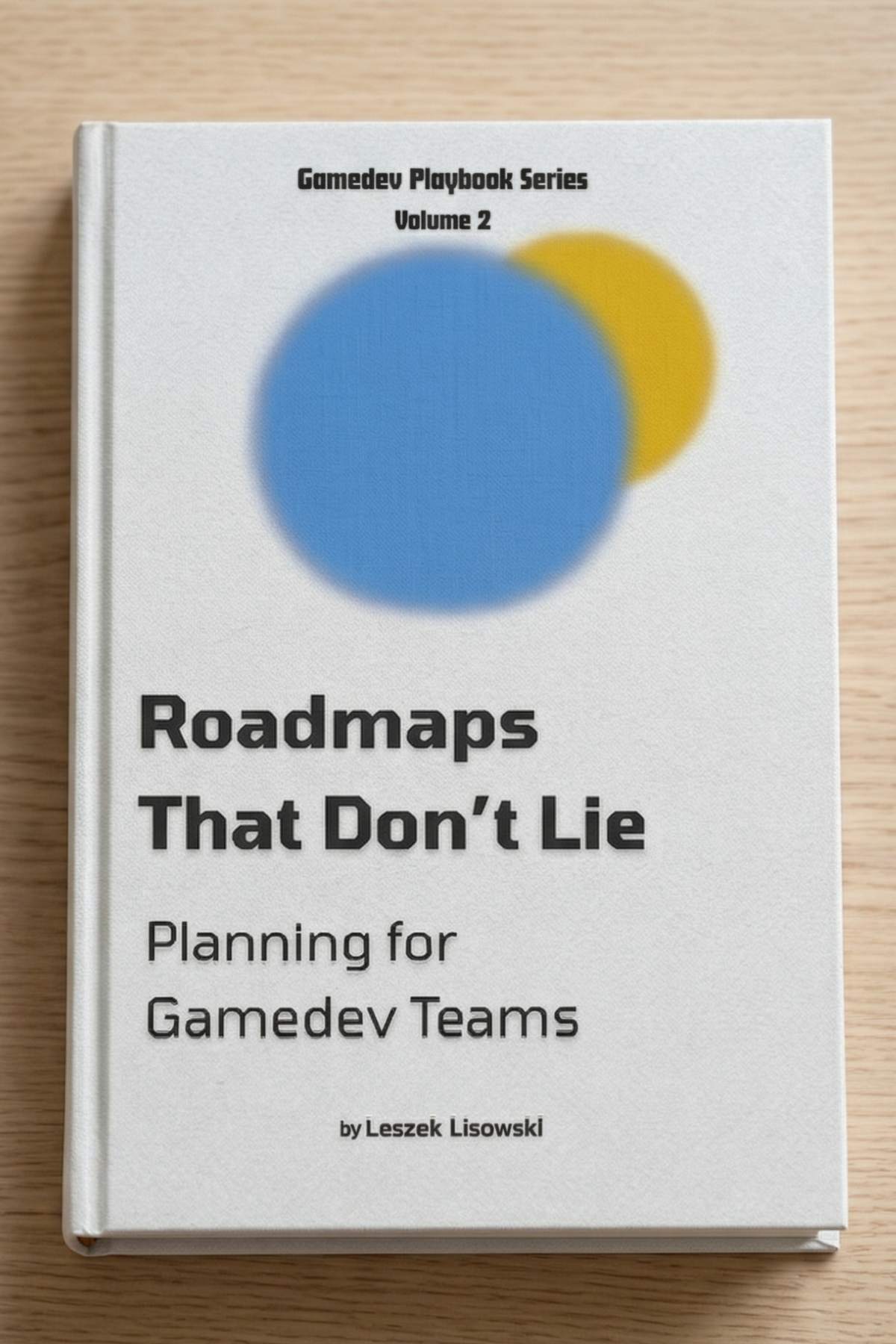
Roadmaps That Don’t Lie
Planning for Gamedev Teams
Forecast with real capacity •
Replan without chaos •
Communicate dates with trust
Most roadmaps fail long before the project does.
They look precise, but ignore real capacity. They promise dates that cannot hold. They are updated too late or too often, breaking trust in the process.
This volume introduces a practical approach to planning that remains useful under real production conditions.
Why Roadmaps Stop Reflecting Reality
Roadmaps often start as clear plans and gradually lose their connection to execution.
Teams commit to timelines without fully understanding capacity. Dependencies are underestimated. Risks are known but not accounted for.
As development progresses, the roadmap becomes harder to trust. Updates feel reactive. Communication becomes cautious or inconsistent.
At that point, the roadmap still exists – but it no longer supports decision-making.
What This Volume Solves
This volume focuses on building roadmaps that remain usable throughout development.
It provides a structured approach to capacity-aware planning, milestone design and continuous re-forecasting.
The goal is to create plans that reflect real constraints, adapt without disruption and support clear communication across the team.
Key Areas Covered
- Understanding different roadmap types and their failure modes
- Planning based on real team capacity and constraints
- Designing milestones that connect planning with execution
- Managing dependencies and risk within the roadmap
- Re-forecasting without breaking alignment
- Communicating timelines without eroding trust
How This Volume Is Structured
The content follows a consistent working model used across the series.
Each section combines:
- principles that define reliable planning
- anti-patterns observed in real roadmaps
- practical tactics for building and maintaining plans
- templates supporting roadmap creation and updates
- anonymized examples showing how plans evolve over time
The focus is on making planning actionable and resilient.
What You’ll Find Inside
This volume includes practical tools and planning structures:
- capacity-aware roadmap templates
- milestone models linking long-term planning with short-term execution
- re-forecasting methods that preserve team alignment
- communication patterns for maintaining trust in timelines
- anonymized examples across different team sizes and project types
Who is this for
Producers / Project Managers
Responsible for planning, forecasting and maintaining delivery timelines.
Designers
Contributing to scope and needing clarity on how plans evolve.
Team Leads
Balancing delivery expectations with real team capacity.
Where This Volume Fits
This volume focuses on planning as a core layer of the production system.
It builds directly on alignment (Volume 1) and connects to scope control (Volume 3).
Without clear alignment, planning becomes unstable. Without scope discipline, even strong plans break under pressure.
This volume can be used independently or as part of a broader system.
No. This volume can be used independently. However, alignment concepts from Volume 1 strengthen planning outcomes.
The focus is on methods and decision frameworks that can be applied regardless of tools.
Yes. The book includes anonymized examples based on real production scenarios.
Yes. The approach is designed to work with different team sizes, including indie teams.
Thank you for subscribing!
Have a great day!
By subscribing, you agree to receive emails about this workbook and occasional updates about other creations. You can unsubscribe anytime. Privacy Policy